

If you have a fixed savings period that is drawing to a close or have received a lump sum as an inheritance or bonus, then you’re likely to be facing decisions about where to hold your cash.
While you may choose to spend some in the short term, it’s also a good idea to look ahead and see how these funds could support your financial plans in the short, medium, and long term.
“Laddering” your savings can be an effective strategy to help mitigate your money’s exposure to tax, secure competitive interest rates, and retain access to funds.
Read on to learn how laddering works and three ways it could support your financial goals.
Laddering involves spreading your savings across multiple accounts with varying maturity terms
A “laddered” approach is a savings strategy which involves distributing your money across several accounts, rather than choosing one.
Typically, these accounts will have different access limits and offer varying interest rates.
For example, you could spread your funds across accounts which are:
- Easy access, so you can withdraw your money any time. These usually have variable interest rates.
- Medium access, with withdrawals requiring a notice period, usually of several weeks. Again, interest rates are variable.
- Fixed term, where your savings are locked away for a specific period of time, usually between six months and five years. Interest rates are usually fixed for the duration.
Using this laddering approach can offer several potential benefits, including:
1. Differing interest rates could boost your savings’ growth
As we’ve mentioned above, different savings accounts usually offer varying levels of growth, which are generally guided by forecasts for how interest rates will change in the months and years ahead.
Variable interest rates can expose your savings’ growth to fluctuations, which can be both positive and negative. Meanwhile, fixed rates mean that you’re “locking in” the rate for its duration. This can protect your savings against drops in interest rates, but also stops them benefiting from growth opportunities if rates rise.
It can be very difficult, if not impossible, to predict which type of account will deliver the highest growth. By spreading your savings across accounts with different terms and interest rates, you can potentially benefit from the whole range of rates available.
Another advantage of having your savings with multiple financial institutions is that your money is protected under the Financial Services Compensation Scheme (FSCS) against firm failures for up to £120,000 per person, per authorised firm.
2. Mixed access can ensure your funds are readily available
While long-term fixed-rate accounts generally offer the highest interest rates, your funds can often be inaccessible for several years.
If you think you may need access to your savings in the shorter term, then strategically dividing your savings across a number of accounts with differing maturity terms could be prudent. This allows you to benefit from higher interest rates on a portion of your wealth, while also ensuring you can quickly access cash should you need it to cover emergency expenses.
The specific mix of accounts will depend on your own financial needs and goals, and we can help you decide on the most appropriate approach.
3. Using savings accounts with different maturity dates could help reduce your tax bill
If you have savings outside the tax-efficient wrapper of an ISA, then the interest you earn could be liable for Income Tax at your marginal rate. However, the tax rate on cash savings interest is set to increase from 2027/28.
Your tax-free earnings are capped at your Personal Savings Allowance (PSA), which is determined by your Income Tax bracket.
The table below breaks down the PSAs and tax rates for the current and next tax years.
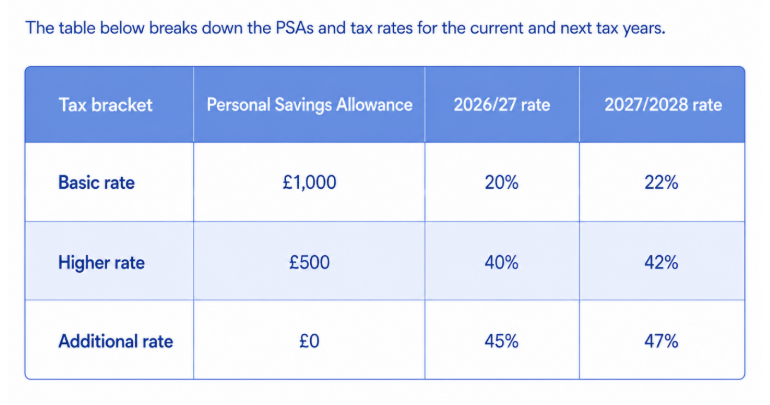
If you have little or no other taxable income, you may also qualify for the Starting Rate for Savings. When combined with the £1,000 Personal Savings Allowance (where applicable), this could allow you to receive up to £6,000 of savings interest tax-free each tax year.
As unused PSA can’t be carried over, you may wish to plan the maturation of your savings so you stay below your tax-efficient threshold.
By laddering your savings to spread interest accruals across multiple tax years, you may be able to mitigate your tax bill by using multiple years’ PSA. However, it’s important to weigh up the benefits of any tax mitigation against possible lost growth with lower interest gains.
You must also consider how and when your chosen account applies interest, as some will pay daily or monthly, while others will add the full amount at the end of the fixed term.
While laddering your savings can be a highly effective strategy for managing growth, accessibility, and tax liability, it’s important to note that interest earned in a Cash ISA is usually tax free.
In 2026/27, you can deposit up to £20,000 into a Cash ISA. From April 2027, you will be limited to £12,000 in a Cash ISA if you’re under 65 (the current rules will remain in place if you’re over 65).
Get in touch
Finding the appropriate mix of savings accounts for an effective laddering strategy can be complex. The IP Cash Hub can help you allocate and diversify your savings across multiple accounts, helping to maximise savings growth and give you control over your wealth.
We’re always happy to help, so if you’d like to learn more about laddering, please email hello@intelligentpensions.com or call 0800 077 8807.
Please note
This article is for general information only and does not constitute advice. The information is aimed at individuals only.
All information is correct at the time of writing and is subject to change in the future.
The value of your investments (and any income from them) can go down as well as up and you may not get back the full amount you invested. Past performance is not a reliable indicator of future performance.
Investments should be considered over the longer term and should fit in with your overall attitude to risk and financial circumstances.