

Have you ever wished you could look into a crystal ball and see what the future holds? Or that you could read your horoscope and confidently believe it might be accurate?
Sadly, there are no guaranteed methods of fortune-telling out there. But when it comes to visualising your financial future, we have a tried-and-trusted approach that could offer useful insights.
Cashflow modelling offers detailed financial projections across a range of scenarios to help you make more informed decisions about reaching your later-life goals.
Read on to find out more.
Build a clear picture of your finances, both now and in the future
Cashflow modelling software uses information about your income, spending, assets, and goals to project how your finances could change over your lifetime.
It can also show you whether you’re on track to achieve your goals and explore how different decisions, such as the age at which you retire, could affect your financial outcomes.
At Intelligent Pensions, we have been using cashflow modelling for over 25 years and were early adopters of this approach for clients. Back then, it was done via spreadsheets, before we moved on to a web-based tool.
We now use Intelliflo, a dedicated all-in-one platform for financial advisers. As they are continually investing in and developing their technology, we know we’re offering you a system that can maximise the potential benefits.
Cashflow modelling underpins our holistic advice process and is integral to the solutions we suggest. We use it as soon as you begin onboarding with us to create a clear picture of your financial position.
From there, we can start building your financial strategy by exploring estate planning, tax efficiencies, and pension planning options.
Your life goals and aspirations are pivotal to the cashflow modelling process. Understanding these means we can run multiple scenarios through the software to show you how your finances could look in a range of circumstances.
For example:
- At what age you’d like to retire
- How you’d like to spend your retirement
- Whether you’d like to make gifts during your lifetime.
Inflation and interest rate assumptions are built into the software to make sure the projections are as accurate as possible.
We can run several scenarios to address how your wealth could look if you:
- Worked part-time
- Were unable to work
- Retired earlier or later than planned.
Plus, we can look at other factors, such as higher-than-expected inflation and market shocks, to understand how your finances might withstand potential challenges.
Annual reviews are an essential part of your financial planning. In these, we’ll look at how your pensions and investments have performed, any changes in your circumstances, and whether your goals have shifted.
Cashflow modelling supports your financial plan in a number of ways
Making data-driven decisions
Financial projections enable you to make strategic decisions that help your wealth work as hard as possible. Tracking performance through regular reviews means we can tweak your strategy if necessary.
Managing risk
Exploring worst-case scenarios through cashflow modelling can help you identify risks and prepare for potential financial shortfalls.
It can also help to mitigate the possible effects of new legislation.
For example, from April 2027, most unused pensions will be included in an estate, so they could be within the scope of Inheritance Tax (IHT). We can use the software to explore whether this could affect you and identify ways to keep your estate below the IHT threshold if necessary.
Creating peace of mind
This approach removes much of the guesswork from financial planning and creates more confidence in your financial future. A clear plan, regularly reviewed and updated, helps to give you some peace of mind that you are on course to meet your later-life aspirations.
Supporting business owners
Cashflow modelling is also a useful tool for business owners, supporting sustainable growth through optimised budgeting and managed cash reserves, while helping to build resilience and mitigate risk.
How cashflow modelling projections can look
To demonstrate how cashflow modelling works, we have created the following examples based on a husband and wife, aged 52 and 50 respectively, to show how their finances could look with different retirement ages. They have:
- A house valued at £400,000 with no mortgage
- Salaries of £85,000 and £30,000 respectively
- Pensions of £250,000 and £100,000 respectively
- Joint expenses of £54,000 annually
- Joint bank savings of £50,000.
These examples assume an 8% total contribution to both pensions. As you can see from the different forecasts, the required pension income and potential shortfall are highlighted. This would enable the clients in this scenario to decide how to mitigate this shortfall if they decided to retire earlier than age 60.
Retirement at age 60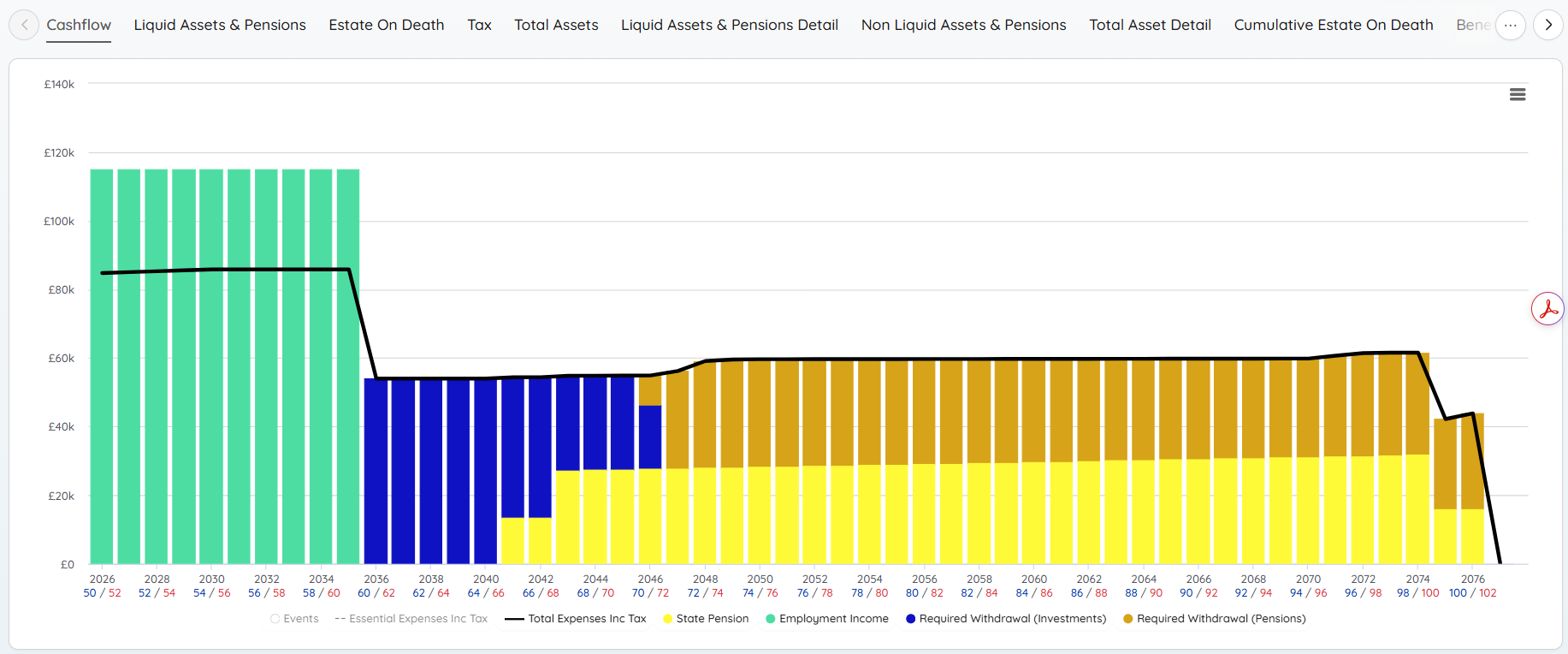
Retirement at age 58

Retirement at age 55

What do these projections tell us?
As the graphs illustrate, the earlier the couple retire, the greater their projected income shortfall becomes.
This is because retiring earlier means giving up employment income sooner, making fewer pension contributions and having less time for their retirement savings to grow. At the same time, their accumulated wealth needs to support their lifestyle for a longer period.
The red areas help to illustrate the scale of the challenge and how different retirement dates can affect the sustainability of their financial plans.
However, identifying a potential shortfall is only the starting point. The real value of cashflow modelling is that we can explore different ways to address it.
For example, could the couple afford to retire at 58 rather than 60 by increasing their pension contributions now? Would reducing expenditure, working part-time or adjusting their investment strategy make retiring at 55 more achievable?
By modelling these alternatives, we can help clients understand the choices available, the compromises they may need to make and the steps they could take to achieve their preferred retirement lifestyle.
Of course, these are projections rather than guarantees, and actual investment returns, inflation and future circumstances will influence the outcome. This is why regularly reviewing and updating the financial plan is so important.
Get in touch
We may not have a crystal ball, but we do have an established and reliable cashflow modelling system that can help you see what your financial future could look like.
We’re always happy to talk to you about your financial plan. Please email hello@intelligentpensions.com or call 0800 0778807.
Please note
This article is for general information only and does not constitute advice. The information is aimed at individuals only.
All information is correct at the time of writing and is subject to change in the future.
Please do not act based on anything you might read in this article. All contents are based on our understanding of HMRC legislation, which is subject to change.
A pension is a long-term investment not normally accessible until 55 (57 from April 2028). The fund value may fluctuate and can go down, which would have an impact on the level of pension benefits available. Past performance is not a reliable indicator of future performance.
The tax implications of pension withdrawals will be based on your individual circumstances. Thresholds, percentage rates, and tax legislation may change in subsequent Finance Acts.
The Financial Conduct Authority does not regulate estate planning, cashflow planning, or tax planning.