

The UK has committed to reaching net zero by 2050. This means achieving a balance between the amount of greenhouse gases produced by human activity and the amount that’s removed from the atmosphere.
Figures published by Energy UK reveal that 20% of the UK’s total emissions come from buildings – mostly from heating. So, while it may feel like a small contribution, making your home more energy-efficient could help create a healthier environment for future generations.
What’s more, putting eco-friendly measures in place could save you money. In light of rising energy prices and changes to the winter fuel allowance, cutting back on costs might be high on your agenda.
Indeed, according to the BBC, standing charges for gas and electricity have risen by 43% since 2019. Additionally, the price cap – the maximum price providers can charge for a unit of energy use – increased by 1.2% to £1,738 a year on 1 January 2025.
Read on to learn how to make your home more energy-efficient.
Find out how energy-efficient your home is
Before you rush into any significant home improvements or renovations, it’s worth checking how energy-efficient your home currently is.
The simplest way to do this is to dig out your most recent Environmental Performance Certificate (EPC).
In the UK, a seller must provide their buyer with a valid EPC before the sale is completed. So, check the paperwork you received when you purchased your home or investment property.
If you can’t find one, or your EPC is more than 10 years old and therefore invalid, it’s worth arranging for a new one to be completed. Having an up-to-date EPC rating could help you decide which home improvements to prioritise.
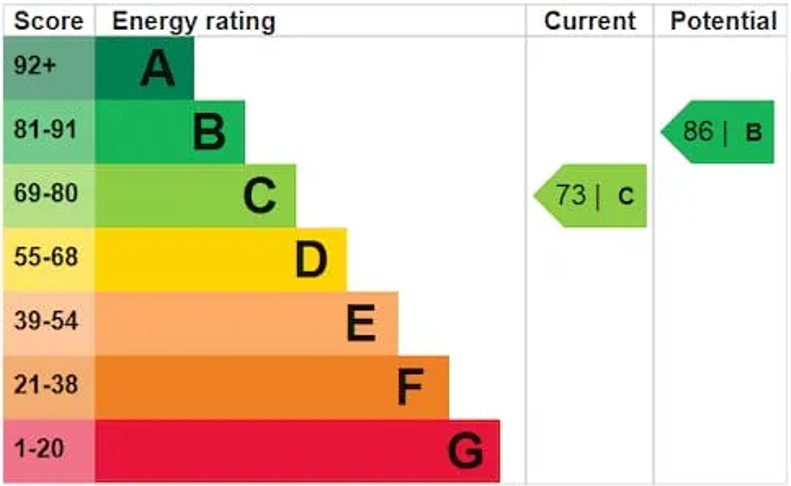
Your EPC will show you how energy-efficient your property is by giving it a rating from A to G. The highest possible rating is A, which indicates an extremely energy-efficient property. The worst rating is G, which suggests a very poor level of efficiency.
As you can see in the example below from epcHome, your property will have both a “current” rating and a “potential” rating. The latter is the rating your property could achieve if you implement some of the improvements that are recommended in your EPC.
Source: epc Home
While there may be some differences in the format and appearance of EPCs in England, Scotland and Northern Ireland, they all contain the same information.
Once you have completed any improvement works, you can arrange to have a new EPC that reflects your home’s new level of energy efficiency. This may make the property more marketable if you do decide to sell.
According to research published by IFA Magazine, 3 in 4 property buyers now look for sustainable features in a home. So, boosting your property’s EPC rating could be a wise investment that could pay dividends when you sell your home or rent out your investment property.
Check whether you’re entitled to any government energy grants
The government has set a target to make as many homes EPC Band C by 2035 as possible. As such, it offers several grants to help homeowners improve the energy efficiency of their properties.
While some of these may not be relevant to your needs or circumstances, it’s worth checking your eligibility as a grant could cover a significant portion of your home improvement costs.
For example, if you live in England or Wales, you may be able to apply for the Boiler Upgrade Scheme (BUS) to cover part of the cost of replacing fossil fuel heating systems with low-carbon systems, such as heat pumps.
Alternatively, you might be able to access financial support from your energy company through the Energy Company Obligation (ECO). This requires all energy suppliers to help homeowners reduce their heating costs by fitting energy-saving measures.
So, you may want to contact your energy prover to find out if you’re eligible.
3 practical tips for making your home more energy-efficient
- Install solar electricity panels – Also known as photovoltaics (PV), solar panels capture the energy from the sun and convert it to electricity that you can use in your home. While this isn’t a budget option initially, it could reduce your energy costs and save you money in the long run.
- Add loft insulation – Research by the Energy Saving Trust has revealed that a quarter of heat is lost through the roof in an uninsulated home. So, insulating your space could be an effective way to boost your property’s EPC rating. It’s also generally reasonably priced and according to Which?, could reduce your energy bills by up to £340 a year, depending on the type and size of your home.
- Upgrade to an eco-friendly heating system – Air and ground source heat pumps capture heat that’s already present in the environment and move it into your property. This means they emit no carbon dioxide. As such, upgrading your boiler could boost the energy efficiency of your property.
Get in touch
While we can’t help with your home improvements, we can support you in managing your finances more efficiently.
To find out more, please get in touch.
Email hello@intelligentpensions.com or call 0800 077 8807.
Please note
This article is for general information only and does not constitute advice. The information is aimed at retail clients only.
All information is correct at the time of writing and is subject to change in the future.