

Diversification has long been regarded as one of the fundamental principles of investing. By spreading capital across companies, sectors, regions, and asset classes, investors aim to reduce risk while maintaining exposure to long-term economic growth. Increasingly, however, achieving genuine diversification is increasingly becoming more difficult. Across developed and emerging equity markets, a small number of companies are accounting for an unprecedented share of index weights and market returns.
The Global Rise of Market Concentration
While the US market receives most attention, concentration is a global phenomenon. Research shows that several major markets – including France, Germany, South Korea and the United Kingdom – have even higher top-ten concentration ratios than the US market1. In some cases, the ten largest companies represent more than half of the entire market capitalisation of the national equity market.
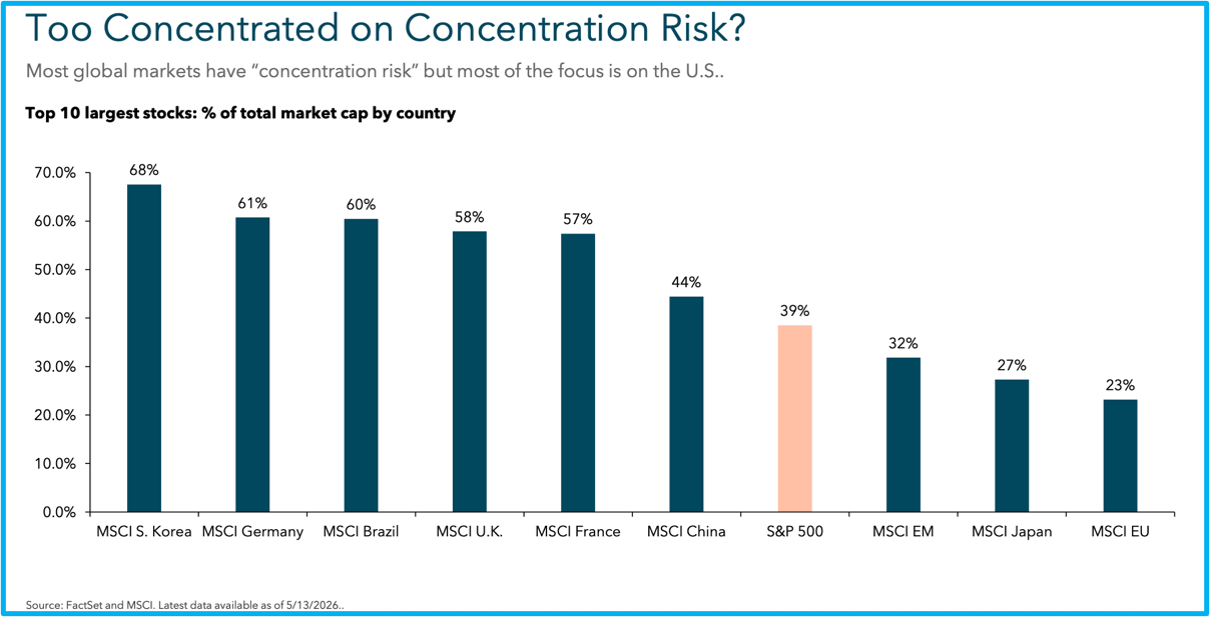
The result is a paradox: investors may own highly diversified index funds containing hundreds of stocks, yet a significant proportion of portfolio performance is driven by only a handful of companies.
The concentration of the US equity market has reached levels rarely seen in modern history. The top ten constituents of the S&P 500 now account for roughly 37-42% of the index, depending on the measurement date. This exceeds the concentration observed during the technology bubble of 2000 and is far above the approximately 19–24% levels seen during much of the period from 1950 to 2010.
The rise of mega-cap technology companies – including Apple, Microsoft, Nvidia, Alphabet, Amazon and Meta – has been a major driver of this trend. In many periods over the last several years, these firms have contributed a disproportionate share of total market returns. The largest companies have benefited from powerful structural themes such as cloud computing, digital advertising, artificial intelligence and semiconductor demand.
Historically, investors buying an S&P 500 index fund expected broad exposure to the US economy. Today, however, over 40 cents of every dollar invested in the index may effectively be allocated to just ten companies. This creates a situation where index investors are far more dependent on the fortunes of a small group of firms than many realise. This is hiding risk that is lurking not far from the surface.
Concentration Beyond the United States
The concentration issue is not limited to the United States. Many global emerging market benchmarks are dominated by a handful of large companies from China, Taiwan, India, South Korea and a few other countries. Technology hardware, semiconductor manufacturing, internet platforms and financial institutions account for a large share of index exposure. Consequently, investors seeking broad emerging market diversification may find that performance is heavily influenced by a relatively small number of firms and economic themes.
This concentration has become particularly pronounced as the global AI and semiconductor supply chain has gained importance. Companies involved in advanced chip manufacturing and technology infrastructure have become increasingly dominant within both developed and emerging market indices. Concentration often reflects the structure of national economies. For example, Canada is heavily influenced by financial and resource companies, while European markets may be dominated by global luxury goods, pharmaceutical or industrial champions.
Market concentration is not inherently negative. Large companies often become dominant because they are highly profitable, innovative and globally competitive. Indeed, concentration has contributed positively to index returns and many collective funds in recent years.
Building Resilient Portfolios in an Age of Concentration
The concentration of equity markets is one of the defining investment themes of the current decade. While these dominant firms may continue to generate strong earnings and shareholder returns, investors should recognise that market-cap-weighted indices are becoming less diversified than headline constituent counts suggest. The challenge for portfolio construction is therefore evolving from simply owning many securities to ensuring exposure to genuinely different sources of risk and return.
As market concentration continues to rise, diversification remains as important as ever – but achieving it requires greater intentionality than in the past. Concentration introduces several risks. Owning hundreds of stocks provides less diversification when a small number of firms drive a large proportion of returns. Many of today’s largest companies share similar characteristics, including exposure to technology, artificial intelligence and digital infrastructure. This creates hidden correlations within portfolios. A disappointing earnings report, regulatory intervention or technological disruption affecting a handful of mega-cap companies can have an outsized impact on broad market indices. This was recently evidenced in the South Korean market.
Active managers who underweight dominant companies may significantly lag benchmarks during periods when concentration continues to rise, even if their portfolios are fundamentally diversified. Many inverstors only look at headline performance and often reach perhaps the wrong conclusions. Selling a fund that is indeed lagging but a fund that is perhaps more robustly constructed to mitigate concentration risk. Unfortunately, in positive times such a fund will not be looked on favourably as it will be failing to beat its benchmark which will be highly concentrated. This risk is rarely acknowledged and as concentration grows so must the education of investors.
Investors may increasingly need to look beyond traditional market-cap-weighted benchmarks. Equal-weight strategies, small- and mid-cap allocations, value-oriented approaches, private markets, alternative assets and genuinely diversified global portfolios can all help broaden sources of return.
Importantly, diversification should not be viewed solely through the number of securities held. True diversification requires exposure to different economic drivers, industries, geographies and risk factors.
As market concentration continues to rise, diversification remains as important as ever – but achieving it requires greater intentionality than in the past and a different mindset from investors. The traditional measure of diversification – the number of funds or holdings owned – is becoming less meaningful. Investors increasingly need to assess the underlying sources of risk and return within collective funds. As market concentration rises, effective diversification requires deliberate portfolio construction across styles, geographies, sectors and asset classes, rather than simply adding more funds. The objective is not to avoid successful companies, but to ensure that portfolio outcomes are not overly dependent on the fortunes of a small group of market leaders.
Douglas Kearney C.A. Investment Director
The above article is intended to be a topical commentary and should not be construed as financial advice. Past performance is not an indicator of future returns. Any news and/or views expressed within this document are intended as general information only and should not be viewed as a form of personal recommendation.