

Investors enter the final months of 2026 facing a difficult combination: economic growth remains reasonably resilient, but inflationary pressures, rising bond yields, geopolitical uncertainty and stretched valuations in parts of the equity market are creating a more challenging backdrop. The central question is whether corporate earnings and economic growth can continue to justify current market valuations, particularly if interest rates remain higher for longer than investors had anticipated.
Global Growth, Inflation and the Uncertain Outlook for Interest Rates
The International Monetary Fund’s (IMF) October outlook forecasts global economic growth of 3.1% in 2026, rising to 3.4% in 2027. However, it expects global inflation to reach 4.7% this year before easing to 4.1% next year. The IMF highlights geopolitical conflict, renewed trade tensions, government debt and a possible reassessment of artificial intelligence (AI) valuations as significant downside risks. It is hard to dismiss any of these risks. The outlook is therefore not necessarily one of imminent recession, but perhaps of greater uncertainty about the price investors should pay for future growth.
The assumption that interest rates would steadily decline has become less secure. Higher energy prices and persistent inflation have complicated the task facing central banks. If inflation proves stubborn, interest rates may remain elevated or rise further, putting pressure on both equity valuations and bond prices.
This matters because financial markets are sensitive not only to the level of interest rates but also to changes in expectations. When investors anticipate lower rates, they are generally prepared to pay more for future corporate earnings. When those expectations reverse, valuations can fall even if companies continue to grow their profits.
Investors should watch three indicators particularly closely: core inflation, wage growth and energy prices. A sustained decline in inflation would provide room for monetary easing and support both shares and bonds. Conversely, renewed inflation would make the outlook more difficult, especially for highly valued growth companies and borrowers with substantial debt. The risk is that central banks face an uncomfortable choice: tolerate above-target inflation or maintain restrictive policy at the expense of economic growth.
AI Enthusiasm, Market Concentration and the Risk of Elevated Valuations
Equity markets have benefited from enthusiasm about AI, strong investment in technology infrastructure and expectations of continued earnings growth. However, a relatively small group of large companies has come to exert considerable influence over major US indices and, consequently, global equity benchmarks. This issue of concentration is not limited to the US but is evident in many global markets as we have discussed throughout the year.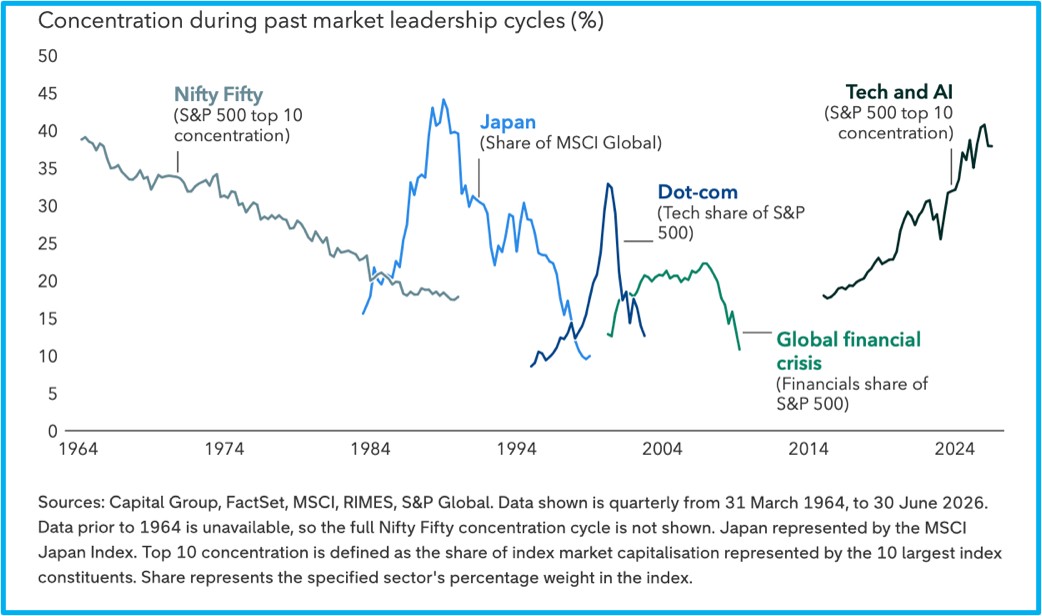
This concentration creates two related concerns. First, investors may be more exposed to a handful of companies than the label “global equity fund” suggests. Secondly, high expectations leave little room for disappointment. If AI investment fails to generate the anticipated returns, or if spending growth slows, the effect could extend beyond technology shares into the wider market.
The key question is not whether AI will transform businesses and economies. It is whether the profits ultimately generated will justify the capital invested and the valuations already assigned to the likely beneficiaries.
Investors should distinguish between companies selling the infrastructure required for AI, businesses successfully converting AI into additional revenue or lower costs, and companies whose valuations depend largely on distant expectations. These are not equivalent investments.
Diversification, Bond Yields and Opportunities Beyond US Equities
Diversification also deserves renewed attention. Funds tracking different indices may appear to offer broad exposure while holding many of the same dominant companies. Comparing underlying holdings, sector weights, geographical exposure and the contribution of the largest positions can reveal risks that headline fund labels conceal.
Higher bond yields have improved prospective income for investors after many years in which yields were unusually low. High-quality government and corporate bonds can therefore play a useful role in portfolios, particularly for investors seeking income or a more predictable return profile.
However, rising yields also cause existing bond prices to fall. Longer-dated bonds are particularly sensitive to changes in interest rates, while corporate bonds carry additional credit risk if economic conditions deteriorate.
Government borrowing is another important concern. Large fiscal deficits and substantial refinancing requirements may keep long-term yields elevated, even if central banks eventually reduce short-term rates. The International Monetary Fund has also warned that rising borrowing by major technology companies to finance AI infrastructure could compete with government debt for investor capital.
Investors should therefore consider both the yield available and the risks required to obtain it. Shorter and medium-dated high-quality bonds may offer a useful balance between income and interest-rate sensitivity, depending on an investor’s objectives and time horizon. High yields alone are not a sufficient reason to extend duration or accept weaker credit quality
The concentration of returns in a small number of US companies does not mean that all other markets are attractive, but it does make geographical diversification worth examining.
The UK, continental Europe, Japan and selected emerging markets offer different sector compositions, currencies, valuations and economic drivers. Some may benefit if investment broadens beyond the largest US technology companies. Others face their own challenges, including weaker growth, political uncertainty, currency volatility or exposure to energy prices.
The important distinction is between diversification and simply buying what has recently underperformed. A cheaper market may offer better value, but only if its earnings prospects, balance sheets and corporate governance justify the investment.
Investors should also look beyond broad geographical labels to individual sectors and businesses. Companies with strong balance sheets, pricing power, recurring revenues and the ability to generate cash through different economic conditions may prove more resilient than highly indebted businesses dependent on favourable financing conditions.
Market Risks, Potential Opportunities and the Importance of Portfolio Discipline
The principal downside risks over the next few months are interconnected. An escalation in geopolitical tensions could push energy prices higher, reigniting inflation. Higher inflation could delay interest-rate cuts or prompt further tightening. Rising bond yields could then pressure equity valuations and increase borrowing costs, weakening economic activity.
A disappointment in AI-related earnings or investment returns could provide a separate catalyst for a market correction, particularly given the weight of technology companies in major indices. A deterioration in government bond markets could amplify the problem by increasing financing costs across the economy.
There are, however, credible positive scenarios. Inflation could moderate as energy pressures ease, allowing central banks to adopt a less restrictive stance. Corporate earnings could continue to grow, while AI investment produces genuine productivity improvements. More balanced market participation could also create opportunities in companies and regions that have lagged the dominant US technology stocks.
The outcome is unlikely to be uniform across asset classes or countries. Selectivity and diversification are therefore more important than making a single, confident prediction about the direction of markets.
For investors, the next few months are likely to reward discipline more than dramatic changes in strategy. The priority should be to understand what a portfolio actually owns, how dependent it is on a small number of companies, and how it would respond to higher interest rates, weaker growth or a sudden reassessment of market valuations.
A sensible review should consider whether the portfolio remains consistent with its objectives, whether sufficient liquidity is available for foreseeable spending, and whether equity, bond and geographical exposures are appropriately balanced. Rebalancing may be preferable to attempting to time a correction, while diversification should be assessed by underlying economic exposures rather than fund names alone.
Conclusion
The central message is straightforward: the global economy remains resilient, but investors face a narrower margin for error. Attractive opportunities remain, yet neither equities, bonds nor cash should be regarded as an automatic safe haven. A portfolio built around reasonable valuations, sustainable earnings, sound balance sheets and genuine diversification is better placed to withstand an uncertain period than one dependent on a single market narrative.
Douglas Kearney C.A. Investment Director
The above article is intended to be a topical commentary and should not be construed as financial advice. Past performance is not an indicator of future returns. Any news and/or views expressed within this document are intended as general information only and should not be viewed as a form of personal recommendation.