

Autumn and winter 2026 may test investors with renewed concerns about inflation, energy prices, interest rates and geopolitics. At the same time, long-term themes such as artificial intelligence, infrastructure investment, income from bonds and global diversification remain relevant. The best response is not to predict every twist in the market, but to build a portfolio that can keep working across a range of outcomes.
Diversification Matters as Markets Become More Concentrated
As we discussed in the July/August Investment View, another issue for fund investors is diversification in highly concentrated markets, which is now a feature of most developed and emerging markets. When a narrow group of stocks drives much of the market return, passive funds and many active funds can become increasingly exposed to the same dominant businesses, sectors or investment themes. Artificial Intelligence, technology infrastructure and semiconductor-related companies have attracted significant investor enthusiasm, but high expectations can also leave valuations vulnerable if earnings disappoint. The Big Tech companies are also large borrowers as capital expenditure budgets need financing and the recent movements in bond markets will be attracting much of their attention.
Through 2026 Geopolitical tensions, including conflict in the Middle East, have pushed oil prices higher, with Brent crude once again above $90 per barrel. Higher energy costs feed directly into inflation, forcing markets to reassess how long interest rates will remain elevated. Tariffs and other interventions have also impacted global economies and behaviour. Anxiety about Donald Trump’s handling of the US economy, and concern that the US president’s war with Iran is driving up inflation, are causing a sell-off in the US bond market.
The Global Bond Market: A Fundamental Repricing
Global bond markets are undergoing a major repricing driven by three key forces: record government borrowing, persistent inflation risks (including energy shocks), and a reassessment of government debt as a “safe haven” asset. As a result, long-term bond yields in the US, UK, Europe and Japan have risen sharply to multi-year highs. Governments are issuing unprecedented levels of debt. The US alone now carries more than $40 trillion in national debt and continues to run large fiscal deficits. Similar pressures exist in the UK, France and Japan.
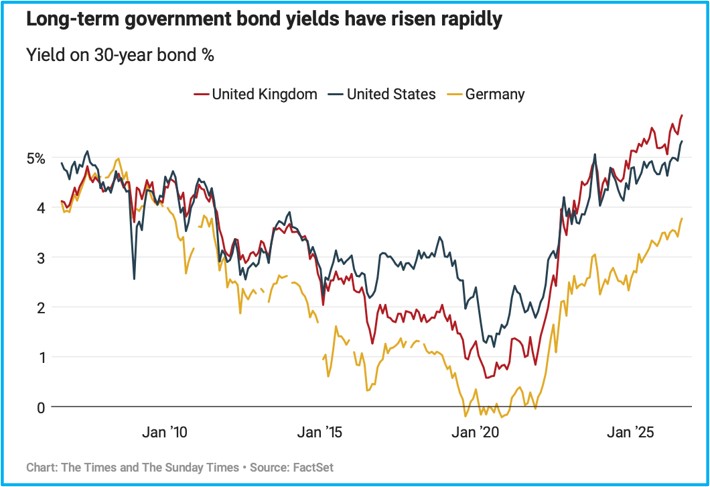
Investors are therefore demanding higher returns to absorb this supply of bonds.
For investors, this creates a dual reality. On one hand, higher yields increase borrowing costs across the economy and put pressure on equity valuations and economic growth. On the other hand, bonds now offer significantly higher income than at any point in the past decade, restoring their role as a meaningful source of return.
The main risks for investors are interest-rate volatility, potential further losses in long-duration bonds, and uncertainty over inflation and fiscal policy. The primary opportunity is the ability to lock in attractive income from high-quality government and corporate bonds, with potential capital gains if and when yields eventually fall.
US Treasuries have traditionally been the world’s safest asset. That status is now being questioned – not because of default risk, but because of fiscal uncertainty, inflation risk and heavy issuance.The US 30-year yield has recently moved above 5%, its highest level since 2007, reflecting this shift in investor expectations.
Long-term bonds are most affected. Bond yields reflect compensation for risk over time. Long-dated bonds are influenced not just by central bank policy, but also by inflation expectations, government borrowing levels, economic growth outlook, geopolitical risk and investor demand for long-duration assets. As these risks rise, investors demand higher yields, pushing prices down.
Rising bond yields also affect stock markets. When government bonds yield 5%, they become a genuine alternative to equities. This puts pressure on high-growth technology stocks, expensive equity valuations and corporate borrowing costs. We have seen this across global markets in the last few months. The AI companies have massive capital expenditure planned which has just got a lot more expensive. Fast growing companies are particularly vulnerable to higher bond yields, which depress the value of future cash flows in financial models. Big Tech Companies have increasingly been turning to foreign debt markets to finance their enormous spending on AI investments with a particular focus on issuing long dated debt.
Higher yields also increase mortgage and loan costs, slowing economic activity and potentially reducing corporate profits. Again, a brake on economic growth.
UK investors face the additional factor of currency risk. US bonds may offer higher yields, but returns can be reduced if the dollar weakens against sterling.UK gilts avoid this issue and now offer materially higher income than in the ultra-low-rate era, making them more attractive for domestic investors.
Higher yields also mean a major shift in opportunity. Investors can now earn significantly more income from high-quality government bonds than in the past decade. If inflation eventually falls and interest rates decline, investors could benefit from steady income from higher coupons and capital gains as bond prices recover. The challenge is timing – no one knows whether yields are near their peak.
The bond market is not simply reacting to short-term economic data. It is repricing the long-term cost of lending to governments. Investors are effectively demanding higher compensation for inflation risk, fiscal uncertainty and long-term debt exposure. Temporary interventions by central banks or governments may stabilise markets, but they do not remove the underlying structural pressures. Treasury Secretary Scott Bessent said that he’s prepared to expand efforts to buy back costlier debt and that the administration will be unveiling a new fiscal initiative to address the highest borrowing costs in years.
The global bond market is undergoing a fundamental reset. After a decade of ultra-low yields, the balance of power has shifted back towards lenders. Governments worldwide, already awash with debt after the economic shocks of recent decades, are being squeezed. The rise in interest costs will not only add to Washington’s debt pile, complicating Trump’s tax and spending plans, but also make life harder elsewhere – including the UK and France ahead of tough budgets. Pressure for solutions is likely to mount on Trump in the run-up to the midterm elections in November.
Douglas Kearney C.A. Investment Director
The above article is intended to be a topical commentary and should not be construed as financial advice. Past performance is not an indicator of future returns. Any news and/or views expressed within this document are intended as general information only and should not be viewed as a form of personal recommendation.